Seagulls: Smart Thieves of the Skies
Wednesday, 2026/08/19198 words3 minutes2072 reads
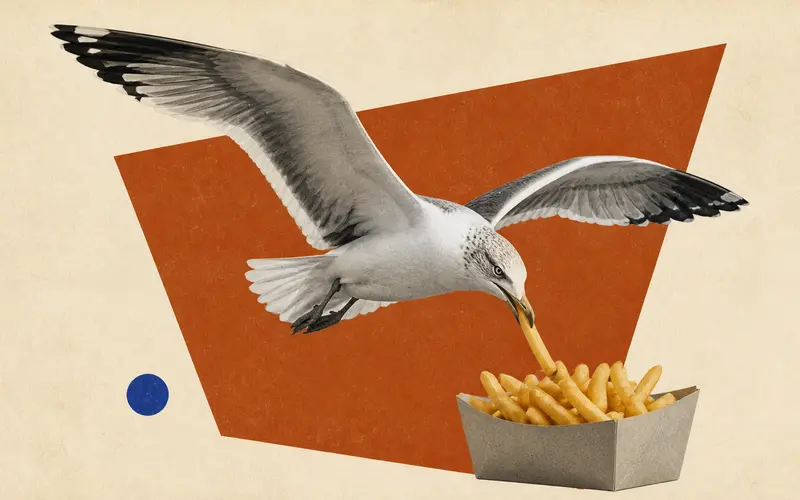
Herring gulls, the archetypal coastal scavengers of the Northern Hemisphere, have increasingly adapted to urban environments, creating frequent conflicts with humans over food. These formidable birds, weighing up to 1.5kg with wingspans reaching 150cm, have become notorious for their bold food-stealing behavior.
Laura Kelley's research at the University of Exeter explored the phenomenon of gaze aversion in herring gulls, discovering that these birds exhibit increased caution when they perceive they're being observed. Building on this principle, she tested whether artificial eyespots—googly eyes affixed to food packaging—could serve as an effective deterrent. The results revealed a bifurcation in gull behavior: some individuals quickly habituated to the false threat, while others remained perpetually wary, suggesting significant individual variation in personality and risk assessment.
This behavioral complexity extends beyond mere opportunism. Franziska Hacker's research demonstrated that gulls engage in sophisticated interspecies observational learning, matching human food choices with 95% accuracy based purely on visual cues. This capacity for object recognition, comparison, and inference represents a remarkable cognitive achievement rarely observed in wild animals. Ironically, while urban gull populations appear abundant, herring gull numbers globally are plummeting due to habitat loss and overfishing, leading to their classification as endangered species in 2021.