Europe's Heatwave Drives Demand for Chinese Air Conditioners
Monday, 2026/07/06262 words4 minutes2413 reads
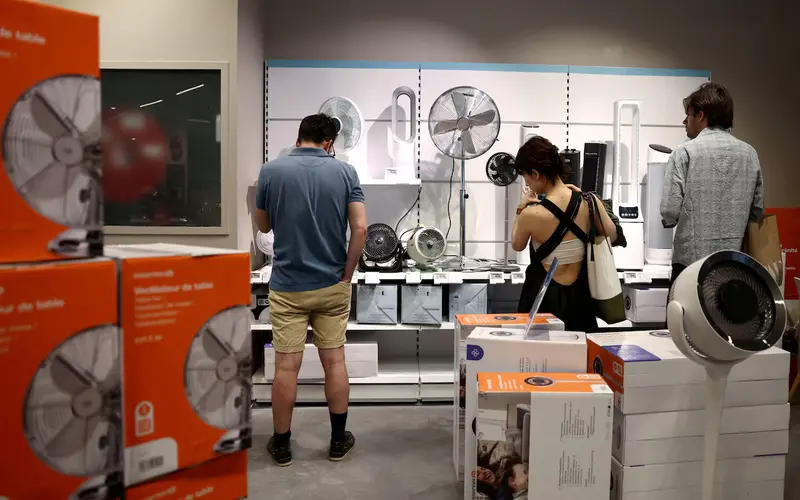
An unprecedented early-summer heatwave sweeping across Europe is fundamentally altering consumer behavior, as households and businesses increasingly turn to air conditioning systems manufactured predominantly by Chinese and other Asian companies. Despite the continent's warming climate, air conditioning penetration remains remarkably low, with the International Energy Agency estimating that only approximately 20% of European households possess such systems—a legacy of architectural designs optimized for heat retention rather than dissipation.
The June 2026 heatwave brought this vulnerability into sharp focus. Paris recorded temperatures reaching 40.9 degrees Celsius, while Britain and Switzerland documented unprecedented June temperature records. The extreme conditions disrupted educational institutions, workplaces, and public services across multiple nations, catalyzing urgent demand for cooling solutions.
Chinese manufacturer Midea exemplifies the commercial opportunities emerging from this climatic shift. The company's PortaSplit model experienced such explosive demand that inventory was depleted across certain distribution channels. German online retailers reported a 37% year-over-year sales increase in May, while French and Spanish markets witnessed a remarkable 108% surge in shipments. The PortaSplit's appeal lies in its portable split-system design, which circumvents the installation challenges inherent in Europe's aging housing stock, where permanent modifications often prove prohibitively expensive or structurally impractical.
However, the proliferation of air conditioning presents significant environmental and infrastructural challenges. Cooling systems impose substantial electrical loads on power grids during peak demand periods, while contributing to climate change through fossil fuel consumption and potential refrigerant leakage. Consequently, European authorities are emphasizing energy efficiency standards, with the European Union proposing enhanced transparency requirements for installation professionals to guide consumers toward optimal equipment choices during crisis-driven purchasing decisions.