Building in Antarctica: Hugh Broughton's Work
Tuesday, 2026/06/02252 words4 minutes3210 reads
On a continent 40% larger than Europe, British architect Hugh Broughton has achieved what few designers can claim: shaping the architectural character of an entire landmass. His eponymous firm has designed scientific facilities for multiple nations and established a distinctly space-age aesthetic born of necessity in one of Earth's most unforgiving environments.
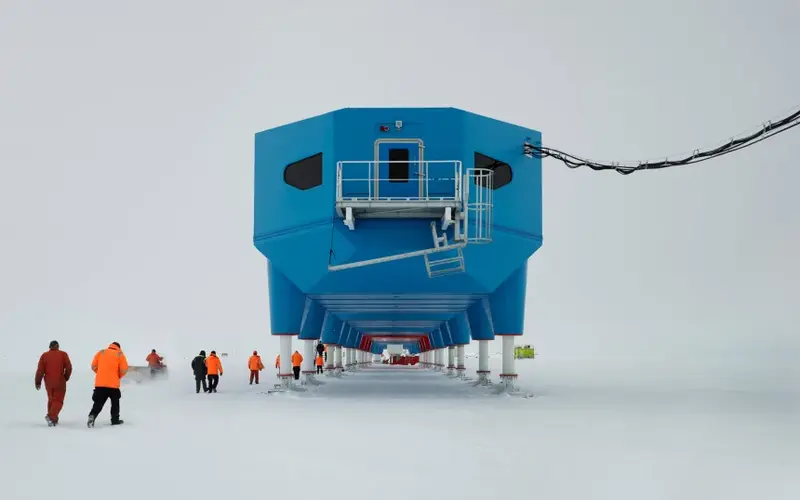
Broughton's entry into polar architecture transpired "purely by chance" in 2004 when he attended a competition briefing, initially attracted by the promise of croissants and penguin photographs. His groundbreaking Halley VI British Antarctic Research Station features elevated modules on hydraulic legs-on-skis that mechanically ascend through accumulating snow. Constructed on the highly dynamic Brunt Ice Shelf—which moves seaward at approximately 13 feet daily—the entire facility can be towed inland when fissures threaten to sever it from the mainland.
Historically, Antarctic design was engineer-led, with habitability often an afterthought. Broughton revolutionized this approach by prioritizing occupant psychology. He meticulously considers spatial relationships, color theory, and even olfactory properties of materials like Lebanese cedar to mitigate sensory deprivation. Window placement represents a critical compromise: while walls retain heat more efficiently than glass, natural light proves essential for vitamin D synthesis and mental wellbeing. His latest project, the 48,000-square-foot Discovery Building, employs triple-glazing and NASA-pioneered aerogels—transparent insulators comprised primarily of gas—to maximize sunlight while minimizing thermal loss.
As geopolitical tensions simmer and the 2048 mining ban review approaches, Broughton's collaborative ethos reflects Antarctica's historical depoliticization. Yet his architectural language is unmistakably evolving into the continent's defining aesthetic, potentially establishing reference points for future generations.