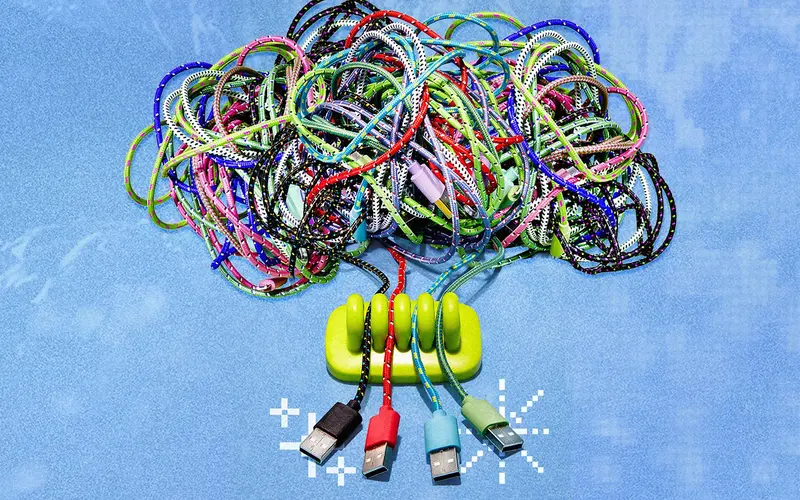
Your Bad Habits Are Destroying Your Charging Cables
Friday, 2026/04/24218 words3 minutes4002 reads
Charging cables represent the most overlooked technology in modern life - until they fail. Michael Pecht, founder of the Center for Advanced Life Cycle Engineering at the University of Maryland, has subjected countless USB cables to rigorous testing to understand their failure mechanisms. His findings challenge widespread assumptions about cable care.
Contrary to popular belief, wrapping techniques are irrelevant to cable longevity. "We've never seen any failures from wrapping them up wrong," Pecht explains. The actual culprit is mechanical stress at the connector junction - where the cable meets the plug. This vulnerable point experiences cumulative damage from repeated bending, similar to metal fatigue in a paper clip.
Robert Hyers, from Worcester Polytechnic Institute, describes the microscopic process: "Bending beyond the elastic range makes the bonds between atoms break and reform as they shift positions. You get this accumulation of defects called dislocations where the atoms don't line up." These dislocations eventually cause the metal to harden and fracture.
Common destructive behaviors include pulling the cable body instead of the connector during unplugging, using inadequately short cables that require stretching, and placing devices on top of cables, particularly in car cup holders where vibration compounds the stress. Experts unanimously recommend investing in braided cables, which utilize reinforced textile exteriors that provide superior protection compared to conventional plastic-coated alternatives.