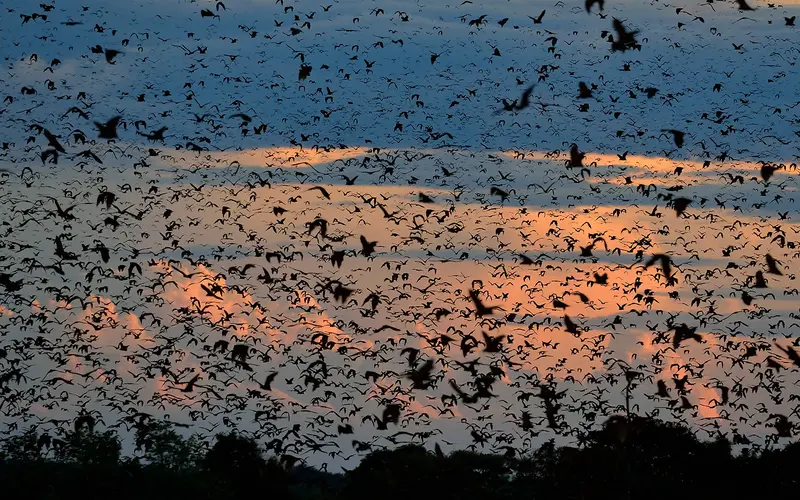
The World's Largest Mammal Migration
Thursday, 2026/06/18232 words3 minutes3525 reads
While half a million tourists flock annually to witness the Serengeti's wildebeest migration, fewer than 1,000 travelers venture to Zambia's Kasanka National Park to observe an even more remarkable phenomenon. Between October and December, an estimated eight to ten million straw-coloured fruit bats converge on this modest 390-square-kilometer reserve, creating the planet's largest mammal migration—eight times the scale of its celebrated Serengeti counterpart.
The nightly exodus is breathtaking. As dusk approaches, millions of bats emerge from the forest canopy in a swirling vortex, their collective wings creating an audible vibration in the air. These remarkable creatures undertake extraordinary journeys, with some individuals traveling up to 96 kilometers nightly to forage. Former chief ecologist Frank Willems calculates that the colony consumes approximately 230-250 tonnes of fruit per night, totaling 330,000 tonnes throughout their stay.
Beyond their spectacular numbers, these bats serve as crucial ecological agents. Bat ecologist Helen Taylor-Boyd notes that Eidolon helvum disperses seeds over distances exceeding those achieved by many vertebrates, including elephants. Satellite tracking has revealed astonishing migration patterns; one bat, aptly named Hercules, flew over 2,400 kilometers. Yet researchers still cannot definitively map their origins or destinations.
Kasanka's appeal lies partly in its obscurity. Once threatened by poaching, the park was revitalized in 1990 through private conservation efforts. Today, it offers an intimate alternative to Africa's crowded safari circuits, where the wilderness remains largely undisturbed and nature's mysteries endure.