Memory Crystals for Data Storage
Wednesday, 2026/02/25242 words4 minutes2263 reads
In 1999, Professor Peter Kazansky encountered a perplexing physical phenomenon at Kyoto University that would ultimately reshape his understanding of data storage possibilities. Researchers experimenting with femtosecond lasers—which emit light pulses every quadrillionth of a second—observed anomalous light scattering behavior that appeared to contradict established physics principles.
The mystery was eventually solved when scientists discovered microscopic nanostructures created by laser-induced "micro-explosions" within silica glass. These structures, approximately 1,000 times smaller than a human hair, form "whirlpools" of light capable of encoding information across five dimensions using light orientation, strength, and three-dimensional spatial coordinates. This breakthrough enabled data inscription at scales smaller than light's wavelength itself.
The urgency of alternative storage solutions has intensified dramatically. Global data production is projected to reach 394 trillion zettabytes annually by 2028, while data centers already account for 1.5% of worldwide electricity consumption—a figure expected to double by 2030. The generative AI boom has exacerbated this crisis, demanding unprecedented computational resources. Critically, up to 80% of stored data is "cold"—infrequently accessed archival material that nonetheless requires continuous power for maintenance.
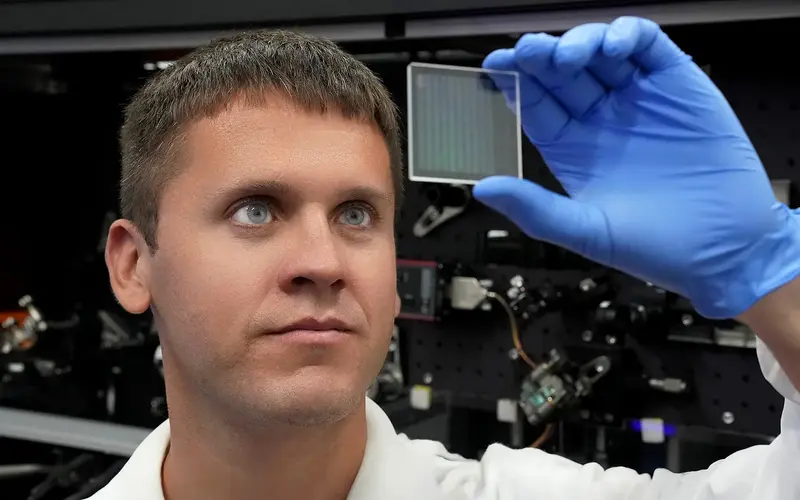
Kazansky's memory crystals offer a compelling alternative. Capable of storing 360 terabytes on a 5-inch glass platter, they require energy only during the writing process and theoretically last indefinitely. His company SPhotonix recently secured $4.5 million in funding and is collaborating with technology firms on prototype deployment. However, challenges remain, including achieving competitive read-write speeds and overcoming infrastructure compatibility barriers that some experts consider formidable adoption obstacles.