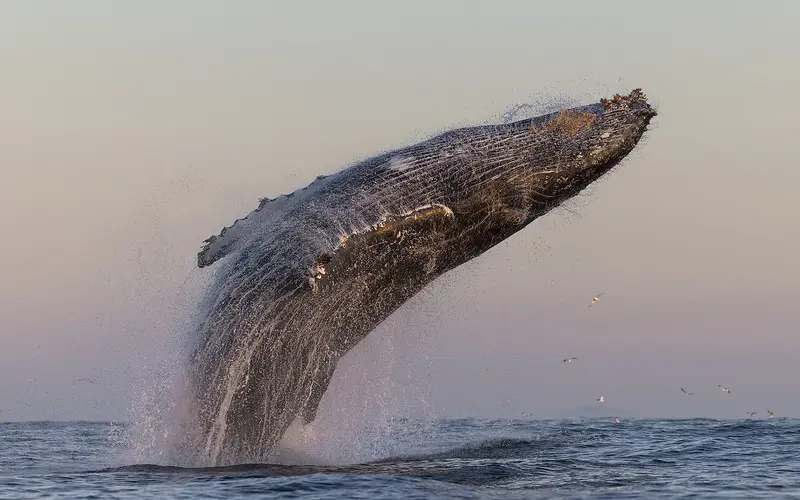
Humpback Whales Form Super-Groups
Sunday, 2026/04/26194 words3 minutes3412 reads
Humpback whales are experiencing a remarkable resurgence. In December 2025, photographers Monique and Chris Fallows documented 304 individual humpback whales in a single day off South Africa's west coast – the greatest number of large whales ever identified in one day in planetary history.
Intense industrial whaling during the 20th century virtually eradicated humpback populations, leaving less than 5% of pre-whaling numbers. However, a global whaling moratorium implemented 40 years ago has enabled populations to rebound. In the southern hemisphere, humpback numbers have surged by up to 12% annually.
Sightings of "super-groups" – defined as gatherings of 20 or more humpback whales within five body-lengths of their nearest neighbor – are skyrocketing. Between 2015 and 2020, annual super-group sightings off South Africa's west coast increased from 10 to 65. Experts hypothesize this phenomenon may result from changes in prey availability, population pressures prompting exploration of new feeding strategies, or simply increased visibility as populations recover. The whales congregate during austral summer when upwelling of nutrient-rich water triggers enormous phytoplankton blooms and subsequent krill abundance. Despite this conservation success, humpbacks still face threats from fishing gear entanglement, vessel strikes, underwater noise pollution, and warming seas.