Apollo v Artemis: How Earth Changed in 58 Years
Wednesday, 2026/04/22206 words3 minutes2591 reads
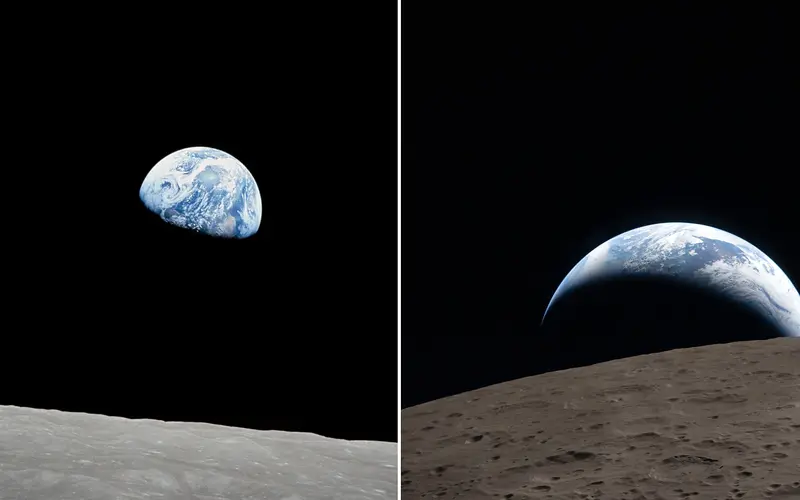
When Apollo 8 commander Frank Borman first witnessed the far side of the Moon in 1968, he was struck by its desolate appearance—a landscape devastated by meteorite impacts and volcanic activity, devoid of color. Yet as the spacecraft completed its fourth lunar orbit, Earth emerged above the horizon, presenting a stark contrast. Bill Anders captured what became known as Earthrise, one of the most reproduced and culturally significant images in human history, galvanizing the nascent environmental movement.
Fifty-eight years later, the Artemis II crew has provided a contemporary counterpart with their Earthset photograph, taken during a seven-hour lunar flyby in April 2026. While geological timescales render this interval negligible, anthropogenic climate change has substantially altered Earth's surface. Atmospheric carbon dioxide concentrations have increased by approximately one-third, and global temperatures have risen by at least 1C since the original photograph.
Experts analyzing both images note visible transformations, particularly in Antarctica and the Southern Ocean. The Antarctic Peninsula has experienced unprecedented ice shelf collapses, with 28,000 square kilometers lost between the two photographs. As glaciologist Benjamin Wallis observes, these changes represent conditions unseen in the past 10,000 years. The juxtaposition of these images serves as a powerful reminder of both Earth's beauty and its vulnerability to human influence.